
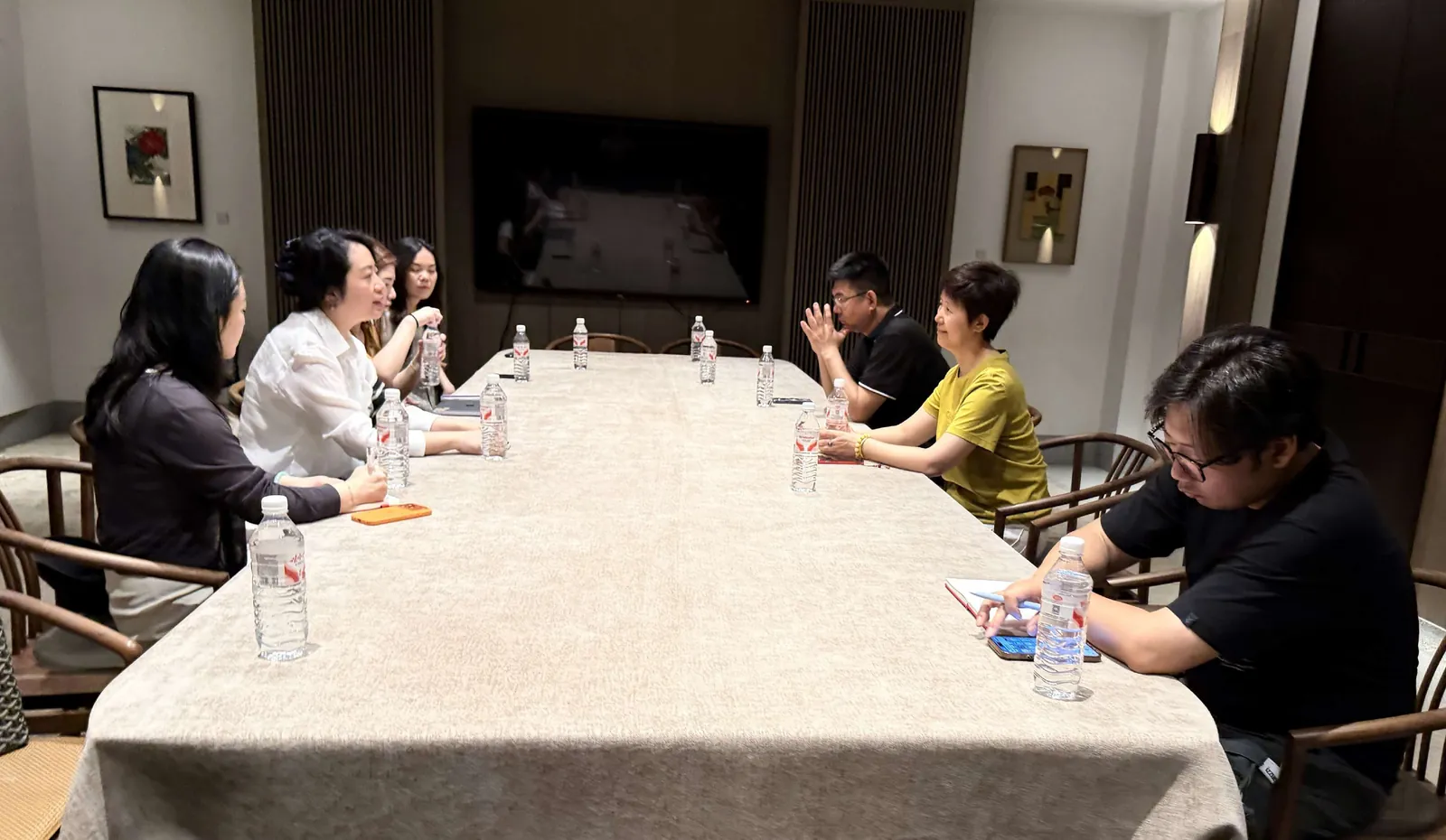
On July 13, China Culture Promotion Association Industrial Investment Association (hereafter referred to as "CCPAIIA") organized a delegation for an inspection and exchange visit to Beijing’s Longfu Temple Cultural District. The delegation was led by Dr. Wang Lina, General Secretary of CCPAIIA; Mr. Zhang Yuanyuan, Vice President of Investment at Qianhai Hengqu Capital and Deputy General Secretary of CCPAIIA; and Yan Fudie, Co-Founder of Longcharm Education. They were accompanied by Zhu Lin, Deputy General Manager of Wuxi Liangxi Cultural and Tourism Development Group. The group was received by Dong Chenming, Deputy Party Secretary of Beijing Xinlongfu Cultural Investment Co., Ltd., General Manager Gao Tianliang, and Head of the Promotion Department Ma Xiaoliang, with whom they held a discussion.
Focusing on Local Growth: From "Introducing IP" to "Cultivating an Ecosystem"
As the leading organizer of this visit, CCPAIIA fully leveraged its platform advantages in connecting cultural industry resources, fostering industry collaboration, and providing investment and financing services. The partnership aligned Liangxi Cultural and Tourism Group’s operational needs with Qianhai Ark’s capital allocation strategies, while also integrating Longcharm Education’s cross-sector resources in industry-education integration. This facilitated a joint inspection involving multiple stakeholders, including local cultural tourism operators, national-level industrial investment institutions, and cross-sector educational organizations.
During the discussion, Ma Xiaoliang shared insights on the operation of the “Longfu Tide Market”: a quarterly cycle with monthly content updates, dynamically adjusting merchant participation based on sales performance; establishing an “Intangible Cultural Heritage Lane” on the first floor, supporting heritage artisans through a model that involves "no minimum guarantees, only commission sharing". The market gathered 13 intangible cultural heritage brands. In July 2026, “Longfu Tide Market” was recognized as one of Beijing’s inaugural “New Consumption Scenarios” benchmark cases.
Focusing on Local Growth: From “Introducing IP” to “Cultivating Ecosystems”
The participants engaged in in-depth discussions on the challenges of operating cultural districts. They concurred that merely importing external market brands incurs high costs and lacks sustainability. A more effective approach is rooted in local cultural soil, promoting the youth-oriented and contemporary expression of traditional culture, thereby enabling the commercial ecosystem to organically "grow" from within the community. Liangxi Cultural and Tourism Group introduced its exploration centered on the Abing Residence in Wuxi, integrating “Guoyue” (Chinese national music), “Guoyao” (Chinese national medicine), and local intangible cultural heritage—an approach highly aligned with the “Fu” (fortune) cultural core of Longfu Temple.
Dr. Wang Lina emphasized that CCPAIIA’s vital role is to facilitate the closed-loop connection among “capital seeking projects, projects seeking venues, and venues seeking content.” The support model of the “Intangible Cultural Heritage Lane” exemplifies a balance between cultural inheritance and commercial innovation, offering a replicable case for cultural asset operation in urban renewal. CCPAIIA will continue to leverage its platform advantages to effectively connect this model with cultural, commercial, and tourism scenarios across different regions. Zhang Yuanyuan, Vice General Secretary of CCPAIIA and Vice President of Qianhai Ark, shared on how capital empowerment can support cooperation between cultural industry funds, special funds, and urban renewal projects. He also indicated that Qianhai Ark will maintain a focus on investment opportunities in cultural consumption, technological cultural tourism, and urban renewal sectors. Yan Fudi, Co-Founder of Longcharm Education, praised Longfu Temple’s practice in blending historical cultural heritage with modern commercial elements, providing a vibrant example of industry-education integration and cultural innovation. She stated that Longcharm Education will continue to leverage its cross-sector expertise in education and culture to support the inheritance and innovative development of cultural exchanges between the two regions.
Deepening Cooperation for Mutual Development
Both parties reached preliminary agreements on introducing Jiangnan cuisine and resource sharing for cultural activities, with plans to undertake reciprocal visits and exchanges under the auspices of CCPAIIA. This inspection serves as a successful example of promoting effective integration among cultural industry projects, capital, scenarios, policies, and operational capabilities. Moving forward, CCPAIIA will continue to utilize its platform advantages in the cultural industry investment and financing sector to facilitate more high-quality projects and capital collaborations across broader scenarios, creating greater value and mutual benefit.