
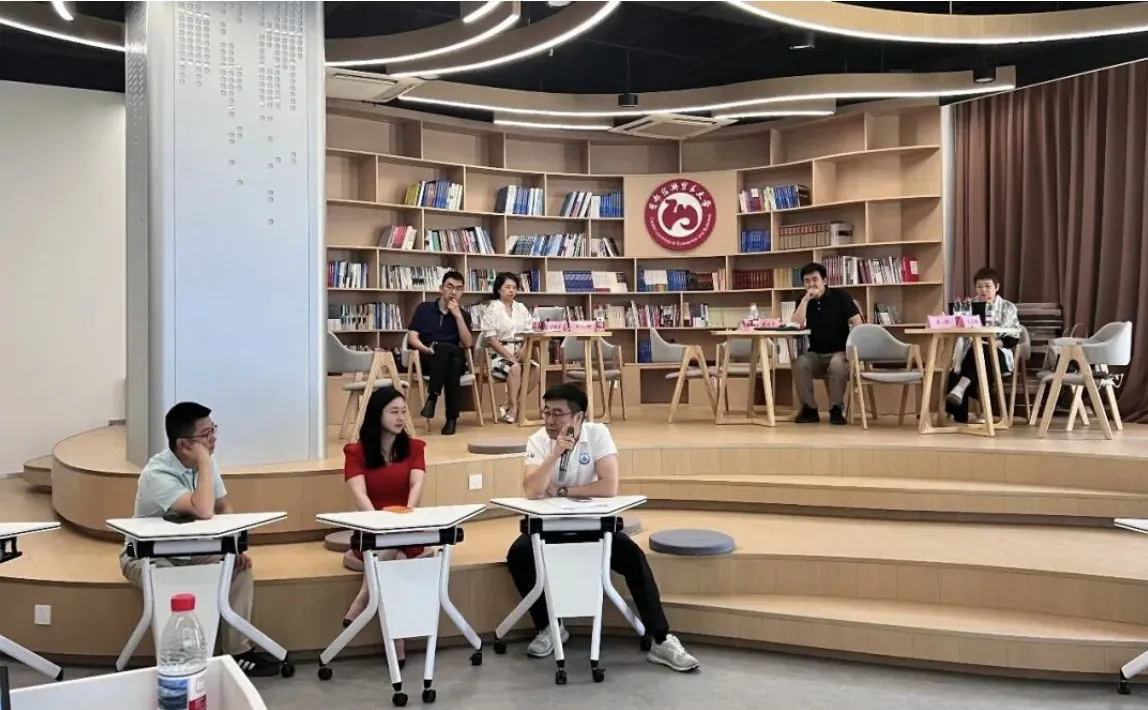
Recently, Beijing Locus X Technology Co., Ltd. (hereinafter referred to as "Locus X") and the Laboratory of Urban Agglomeration System Evolution and Sustainable Development (a provincial and ministerial key laboratory) at Capital University of Economics and Business (CUEB) held a "Digital Twin City Lab and Web4 Spatial Intelligence Platform Technology Exchange" in Beijing. Dr. Wang Lina, Co-founder of Longcharm Education and General Secretary of the China Culture Promotion Association Industrial Investment Association (CCPAIIA); Dr. Yang Shaofeng, Founder of Locus X; Li Ruihua, Deputy General Manager of Locus X; together with university leaders and representatives including Professor Ma Baobin, Dean of CUEB; Professor Mao Qiliang, Executive Director of the Lab; Professor Pan Na, Assistant to the Dean; Associate Professor Wang Linlin, Chair of the Urban Economics and Management Department; Associate Professor Song Xinran, Chair of the Public Administration Department; Associate Professor Sun Yukang, Chair of the Regional Economics Department; Lecturer Huang Xianming from the Public Administration Department; and Lab Supervisor Lu Hui, jointly attended the meeting. They conducted in-depth discussions on mega-city refined governance, the Web4 spatial internet engine, and commercial applications of digital twins. As a key portfolio company of Longcharm Group, Locus X fully demonstrated its technological leadership in Web4 (AI + blockchain + digital twins) and its ability to deliver major benchmark projects.
Industry-Academia-Research Collaboration Outlook: Complementary Technologies, Joint Scenario Building
During the exchange, Professor Mao Qiliang introduced the lab's strategic positioning as the first provincial/ministerial key laboratory in the field of urban governance in China, along with its core technology modules including the all-time data hub, intelligent reporting system, and 12345 data analysis platform. The two parties reached preliminary intentions for future cooperation: first, to integrate human factors engineering research with Locus X's virtual-real interaction technology to enhance immersive experiences; second, to explore automated point cloud data update mechanisms for underground spaces such as mines and subways; and third, to open Locus X's low-code tools and interfaces to empower university teaching and the transformation of research outcomes.
Cutting-Edge Technology: The Web4 Spatial Internet Engine
Dr. Yang Shaofeng highlighted the company's self-developed Web4 Spatial Intelligent Internet Map Engine. Unlike traditional GIS maps, this engine adopts a distributed computing unit architecture, enabling efficient publishing and rendering of massive 3D scene data and supporting tens of millions of users interacting online simultaneously. Moreover, the engine innovatively integrates storage-computation integration and blockchain technology: each tile serves as both a storage unit and a computing unit, combining spatial computing, AI computing, and physical world mapping, thoroughly overcoming the performance bottlenecks of traditional layered loading.
Benchmark Project Validation: From Mount Tai Digital Twin to Shenzhen Digital Twin City
Locus X has created multiple industry benchmark cases in smart cultural tourism and urban governance. Among them, the Mount Tai Digital Twin Project achieves millimeter-level precision modeling of the scenic area, integrates 1,000 surveillance cameras, enables real-time motion capture and virtual avatar mapping for tens of thousands of tourists, and supports VR immersive tours and social interaction. In the smart business scenario, the company has built online museums and auto showrooms featuring AI digital human guides, 3D try‑on and test‑drive experiences, and cross‑regional multi‑person co‑screen interaction, forming a closed loop for e‑commerce transactions.
Subsequently, Li Ruihua shared a development case study of the Shenzhen Visual Urban Space Digital Platform (a reference standard for the Ministry of Housing and Urban-Rural Development’s CIM platform), which was led by the core team of Locus X. The project went live within one year, integrating data from seven departments including natural resources, housing and urban-rural development, and the Grid Office, achieving unified coding management of "land – building – housing – owner". The platform supports concurrent access by several thousand users, with an average response time of only 0.03 seconds – far exceeding the ministry's standard of 1,000 concurrent users / 10 seconds – and has operated with zero downtime for two consecutive years. During the epidemic, the platform assisted the government in rapidly tracking the activity trajectories of confirmed cases and completed the delineation of all controlled areas and resource dispatch within a single day, demonstrating outstanding practical value.
Locus X Receives High Recognition from University Leadership; Clear Intention for Further Cooperation
In the concluding session of the meeting, Dean Ma Baobin spoke highly of Locus X's technological strength and project achievements. He noted that Locus X's Web4 spatial internet technology is highly aligned with the college's research directions in urban governance, digital twins, and related fields, and that Locus X possesses verifiable real-world cases such as Shenzhen and Mount Tai, reflecting solid implementation capabilities. Dean Ma clearly expressed his intention to engage in further in-depth exchanges, looking forward to substantive cooperation with Locus X in research breakthroughs and joint scenario development.
Strong Alliance to Accelerate Web4 Industrialization
This exchange marks an important step forward for Locus X in industry-academia-research collaborative innovation. As a key investee company of Longcharm Technology, Locus X will continue to deepen its presence in the Web4 spatial intelligent internet and digital twins areas, driving large-scale implementation of mega-city governance, smart cultural tourism, and commercial reality replication scenarios.