
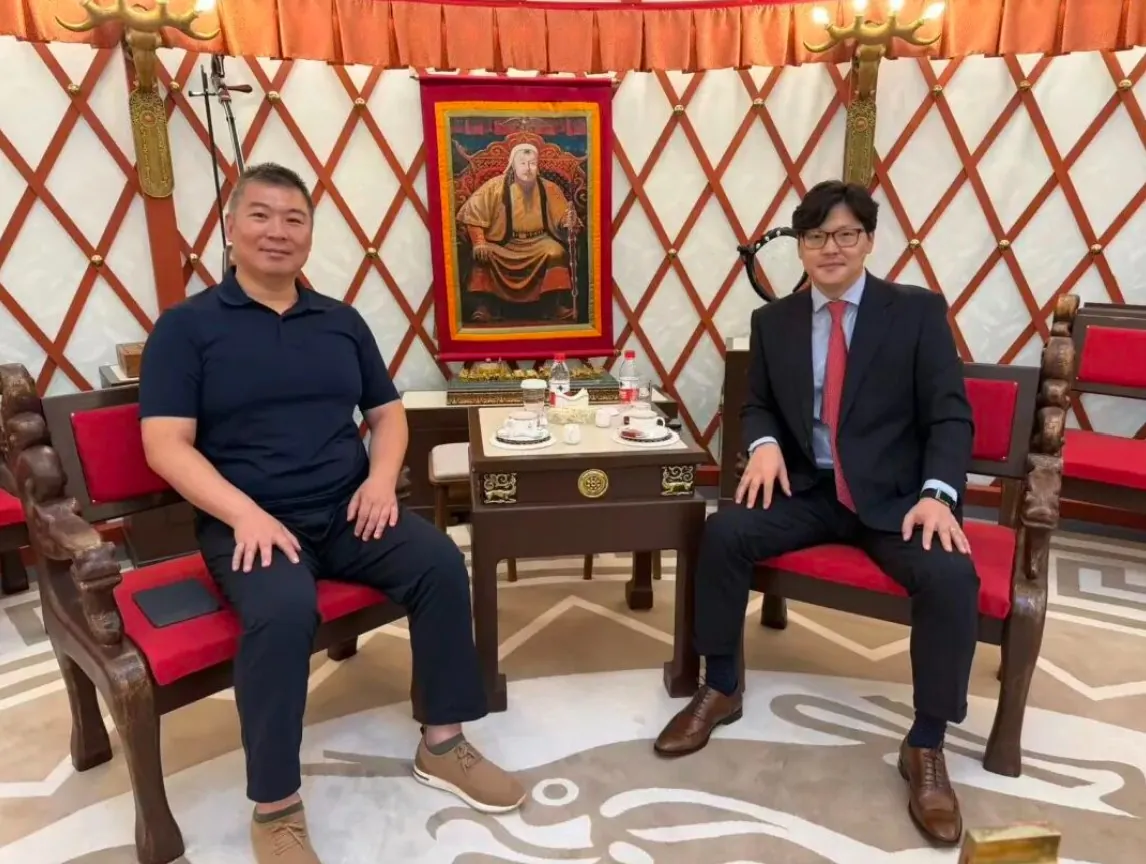
On August 25, Mr. Zhao Mengda, Executive Director of Shanghai Prospect Development Institute (SPDI), Council Member of China Culture Promotion Association, Chairman of China Culture Promotion Association Industrial Investment Association (CCPAIIA), and CEO of Longcharm Group, visited the Embassy of Mongolia in China together with Dr. Wang Lina, Executive Director of Shanghai Prospect Development Institute, Council Member of China Culture Promotion Association, Vice Chairwoman of CCPAIIA, and Co-founder of Longcharm Education. They met with Mr. Gombo Bumtsend, Minister Counsellor and Deputy Head of Mission of the Embassy of Mongolia in China. The two sides held discussions on China-Mongolia cultural exchange, cultural tourism cooperation, continuing education, youth talent development, healthcare-related cooperation, and the implementation of related industrial projects.
During the meeting, Mr. Gombo Bumtsend introduced Mongolia’s economic and social development, the main functions of the Embassy of Mongolia in China, and the Embassy’s work in promoting people-to-people exchange, cultural presentation, economic communication, and public diplomacy. He noted that China and Mongolia are close neighbors with longstanding ties and a solid foundation for cooperation in culture, education, tourism, healthcare, agriculture and animal husbandry, and related industries. Mongolia’s vast grasslands, natural ecology, outdoor sports resources, recreational vehicle travel potential, and cross-border tourism resources provide broad opportunities for practical cooperation with Chinese institutions.
Mr. Zhao Mengda introduced the development history, platform resources, and future positioning of Shanghai Prospect Development Institute. He stated that the Institute originated from the “Prospect Plan” and has long participated in national-level talent development, regional development training, and east-west cooperation initiatives. Through these efforts, it has accumulated extensive experience in education and training, project organization, and resource integration. In its next stage of development, the Institute is willing to leverage its platform strengths to explore sustainable cooperation mechanisms with Mongolian institutions in youth development, continuing education, industrial talent training, cultural exchange, cultural tourism, and high-level visits.
Mr. Zhao added that the Institute could promote a number of focused and executable pilot projects with demonstrative value. These may include short-term study visits, thematic training programs, and cultural exchange activities for young people from China and Mongolia; online-offline continuing education programs jointly developed with Mongolian institutions by introducing international university course resources; industrial study visits and thematic training for entrepreneurs, industrial parks, and professional talent; and multi-party education and talent development projects in areas such as artificial intelligence, green development, cultural industries, healthcare, and cultural tourism, supported by resources from China, Mongolia, and international universities.
Dr. Wang Lina introduced the work of China Culture Promotion Association and its Industrial Investment Association, and further highlighted the Institute’s advantages in connecting domestic and international university resources. She noted that cultural and tourism industries are important vehicles for enhancing people-to-people understanding and promoting regional cooperation and industrial integration. China and Mongolia have strong complementarities in traditional culture, grassland ecology, cultural tourism resources, healthcare needs, youth education, and regional industrial collaboration. Future cooperation may focus on cultural exchange activities, cross-border cultural tourism projects, recreational vehicle travel, outdoor sports, study tours, women’s development and youth leadership programs, healthcare and cultural tourism resource promotion, and industrial investment exchange platforms.
Dr. Wang also stated that Shanghai Prospect Development Institute has long been engaged in talent development, continuing education, international exchange, and regional development projects, and has built strong capabilities in curriculum organization, program design, and project execution. Building on its existing resources, the Institute can further connect overseas universities, Chinese universities, continuing education institutions, and industry experts to support China-Mongolia educational exchange through international course introduction, joint training programs, study visits, youth leadership development, and industrial talent training. The Institute is ready to serve as a bridge for practical cooperation between Mongolian institutions, Chinese universities, and international higher education partners.
The two sides also exchanged views on cooperation in the healthcare sector. Participants noted that Mongolia has distinctive advantages in natural ecology, grassland resources, traditional medicine, and wellness tourism, while China has mature experience in healthcare services, health management, industrial operation, market channels, and supply chain organization. Future cooperation may explore health management, wellness tourism, cross-border healthcare services, and the promotion of specialty health products through project research, resource matching, and pilot initiatives.
Both sides agreed that China and Mongolia have a strong foundation and clear practical needs in cultural exchange, cultural tourism, continuing education, healthcare-related industries, and related industrial cooperation. Going forward, the parties will further strengthen communication, establish regular coordination around specific cooperation areas, and prioritize pilot initiatives in youth exchange, continuing education, cultural and tourism activities, and industrial study visits. As conditions mature, cooperation may be expanded to broader industrial collaboration and platform development, contributing to people-to-people friendship and practical cooperation between China and Mongolia.