Fostering Innovation and Entrepreneurship through the Integration of Language, Culture, and Industry
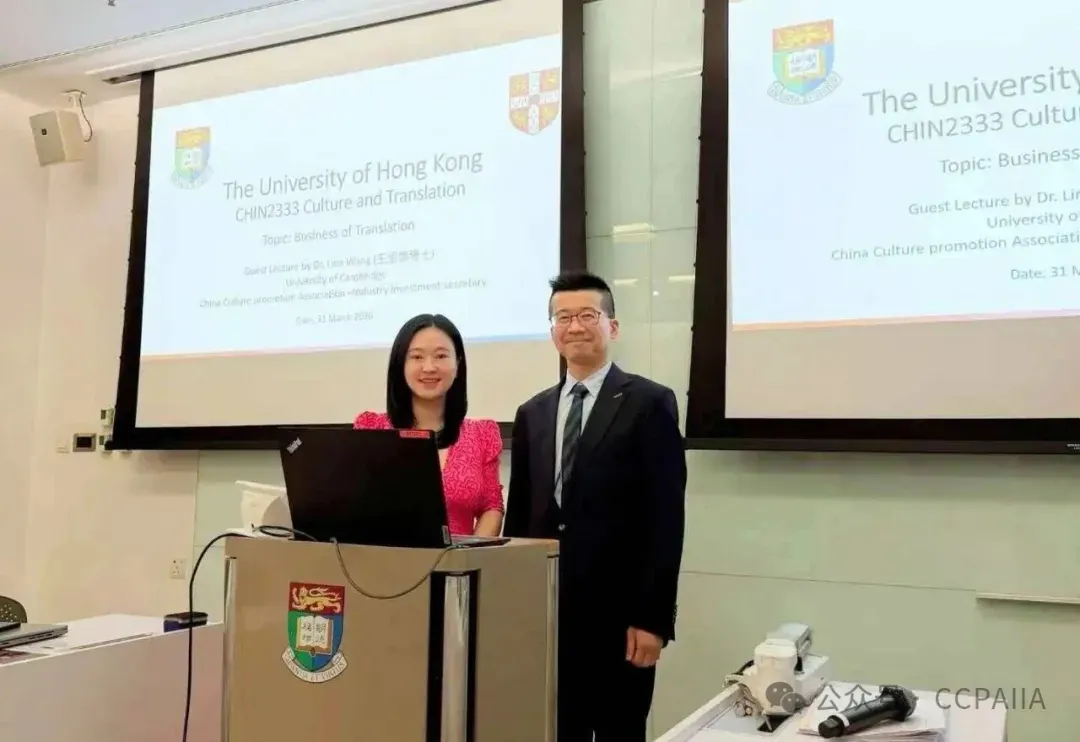
On March 31, at the invitation of Dr. John Chun Yin WONG of the School of Chinese at The University of Hong Kong, Dr. Wang Lina, the co-founder of Longcharm Education, General Secretary of the China Cultural Promotion Association Industrial Investment Association, visited the University as a guest lecturer. She engaged with the Translation students on the theme “The Business of Translation,” delivering a talk that seamlessly combined academic depth with industry insight.
In an era where artificial intelligence is profoundly reshaping ecosystems across sectors, Dr. Wang focused on the future trajectory and employment prospects of linguistics. Drawing from her extensive practical experience in the cultural and tourism industries, she opened a new window for young scholars to understand "how language empowers industries, and how industries, in return, enrich the discipline.”
During her talk, Dr. Wang began by examining the transformation of linguistics in the AI age, emphasizing that language is no longer merely a tool for communication but is increasingly becoming a core asset within cultural industries, the digital economy, and globalization strategies. She analyzed diverse career paths for language majors—ranging from content creation and cross-cultural communication to intelligent interaction—and shared how innovative projects in the cultural tourism sector have leveraged cultural narratives and business models to achieve breakthroughs in recent years.
Particularly noteworthy were two flagship projects supported by the Investment Branch: “Velowind” and “Shan Hai Fu”.
Velowind focuses on “Smart Outdoor + Rural Cultural Tourism,” integrating outdoor vehicle rentals, event operations, equipment trading, and guide incubation into a comprehensive one-stop platform. The project employs an “Outdoor+” model that links sports, educational travel, and wellness scenarios, exploring replicable pathways for rural cultural tourism integration.
Shan Hai Fu specializes in mobile living and travel, leveraging an ecosystem of RVs and standardized campsites in regions with stunning natural scenery but limited infrastructure. It aims to create immersive, sustainable travel experiences by investing in, constructing, and operating these campsites, injecting sustainable consumption vitality into local tourism with high-quality landscapes.
These two projects exemplify how digital platforms can deepen the integration of outdoor lifestyles with rural resources, and how physical campsites can foster new mobile living consumption scenarios, thus highlighting the vast potential for cross-sector collaboration and innovative models within the cultural industry.
The students showed keen interest in the operational logic and practical implementation of these initiatives. The discussion resonated strongly with the audience, prompting in-depth exchanges on future entrepreneurial directions, the intersection of AI and linguistics, and career transformation pathways for language professionals. Many students expressed that these projects demonstrated how language skills and cultural understanding can translate into creativity and competitiveness in real-world industries, inspiring their own aspirations for cultural innovation and enterprise.
As General Secretary of the Industrial Investment Association,, the co-founder of Longcharm Education, Dr. Wang not only shared cutting-edge industry developments but also exemplified the branch’s active efforts to promote “industry-education integration and collaborative talent cultivation.” She emphasized that the high-quality development of the cultural industry relies on young talents with international perspectives, humanistic qualities, and industry insight. The branch will continue to bridge academia and industry, helping outstanding students find meaningful careers in cultural heritage and innovation, contributing their youthful energy to the nation’s cultural and creative sectors.
This visit to The University of Hong Kong was more than an academic-industry dialogue; it was a resonance between youth and the times. Through vivid case studies, forward-looking perspectives, and sincere sharing, Dr. Wang reaffirmed the evolving value of linguistics in the new era and infused new vitality into cultural talent exchanges between Hong Kong and the Chinese mainland.